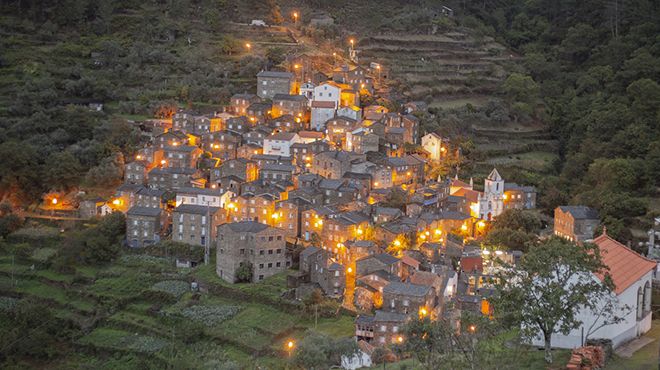
The Hidden Stone Village of Piódão
Drive two hours east of Coimbra into the folds of the Serra do Açor and the road will begin to narrow, the air will cool, and the world will slow. Then, suddenly, Piódão appears — a village of dark schist houses stacked against a steep hillside like a handful of slate tiles dropped from the sky. Nothing quite prepares you for it.
A Village Frozen in Time
Piódão is one of Portugal's aldeias históricas — historic villages — but unlike the more touristed Monsanto or Óbidos, it still feels genuinely untouched. The houses are built almost entirely from schist, the dark stone that surrounds the valley, giving the village a monochrome beauty that contrasts sharply with the vivid blue trim of the church and doorways. This colour combination is not arbitrary: the blue represents the sky and the hope of heaven; the dark stone, the earth from which the community was built.
The village population today is fewer than a hundred permanent residents, mostly elderly. The young left for Coimbra and Lisbon decades ago, chasing jobs and modernity. What they left behind is a living museum that feels both melancholy and deeply beautiful. Cats sleep on warm stone walls. The smell of wood smoke drifts from chimneys even in spring. A woman hangs washing from a second-floor window, pausing to look down at you with neither surprise nor particular interest.
Getting There: The Journey is Half the Point
There is no direct bus to Piódão. This is, in many ways, a blessing. The only real way to arrive is by car, following the N112 through the serra from Arganil or climbing from Góis along roads that hug the edges of forested ravines. The drive itself is a destination. In spring, the hills are carpeted in yellow broom and white rock roses; in autumn, the chestnut trees turn amber and the villages along the way sell roasted chestnuts from roadside stalls.
Budget roughly two and a half hours from Lisbon and one hour forty from Porto. The final descent into the village — a tight, winding road that drops sharply into the valley — demands a confident driver. Park at the designated area at the village entrance; the lanes inside are far too narrow for anything but foot traffic.
Local Tip
Visit on a weekday between October and April and you may have the village almost entirely to yourself. Summer weekends bring coachloads of day-trippers. The village is at its most atmospheric in the early morning, when mist fills the valley and the stone lanes are quiet.
What to Do in Piódão
There is, by design, very little to "do" in Piódão. The pleasure is in wandering. Follow the steep lanes upward to the church of Nossa Senhora de Conceição, whose white-and-blue façade looks almost impossibly bright against the surrounding grey stone. Sit on the steps, look out over the valley, and do nothing in particular. This is Portugal at its most honest.
The small Interpretive Centre near the church entrance offers good context on the village's schist-building traditions and the social history of the serra. It's worth an hour of your time. For those who enjoy walking, a well-marked trail descends from Piódão into the Alvoco Valley — a two-hour route through oak and laurel forest that rewards with a cool river gorge at the bottom.
Lunch in Piódão means the single restaurant on the main square, O Fontão, which serves straightforward mountain food: kid goat stew, grilled trout from the local river, and thick açorda (bread soup). Order the house wine without hesitation. It arrives in a ceramic jug and costs almost nothing.
Where to Stay
A handful of small guesthouses (casas de campo) in and around Piódão offer overnight stays in restored schist buildings. Staying the night is transformative: once the day-trippers leave around 5pm, the village becomes ethereally quiet. Watching the sun set behind the serra from the churchyard, with the valley below filling with shadow, is one of those travel moments that stays with you.
SweetCottage manages several properties in the broader Serra do Açor area — the perfect base for day trips to Piódão combined with the wild swimming holes of the Alvoco River and the market town of Arganil.
The Bigger Picture: Schist Villages of the Centre
Piódão is the most dramatic of Portugal's schist villages, but it is not alone. The broader Aldeias do Xisto network encompasses 27 villages spread across the central region, each with its own character. Figueira de Castelo Rodrigo to the north, Cerdeira and Talasnal to the south — together they form one of Portugal's most rewarding slow travel circuits, yet remain almost entirely unknown to international visitors.
If you have a week in central Portugal, consider building a loose loop: Piódão to Góis (for kayaking on the Ceira River), east to Castelo Branco, then north through the Estrela mountains. You will pass through a Portugal that most travel writing ignores entirely, and be better for it.
Explore More Hidden Gems
More stories from Portugal's secret corners.